Ghost Sites of the Web: Where Dead Sites Live On... Where Web Disasters Are Still Fresh

Identifying and critiquing aging, abandoned, and derelict web sites since 1996. Includes a Web 1.0 screenshot library, essays, and "The Museum of Interactive Failure." By Internet Marketing veteran Steve Baldwin.

January 28, 2008

Steve Gilliard's Timeless Tips For Avoiding Valentine's Day Depression

Steve Gilliard's Timeless Tips For Avoiding Valentine's Day DepressionSteve Gilliard, who died far too early last year, had a lot to say about Love in the Age of the Modem, and his classic, laugh-until-you-cry treatise on the Valentine's Day blues, "Valentine's Day: The Meaning of Hell," written for Netslaves.com, is as relevant today as it was when he wrote it in 2001.

Steve's recipe for evading Valentine's Day depression was straightforward. Instead of wallowing in your misery, take steps to distract your mind from your wretched isolation. So watch movies ("romance will not be on your mind as the Germans shoot it out with hordes of Russian infantrymen"), play video games ("Unreal Tournament, Rainbow Six, Diablo"), drink ("the catch-all solution to personal pain"), watch TV ("there is no Valentine's Day on ESPN"), and if necessary, work, perhaps by "building some code for a doomed website." Don't think, don't brood, find a way to pass the time and you'll be OK, because Valentine's Day, despite its acute horror, is just "one intensely painful day which reminds you of your flaws and failures like no other." So get through those nasty 24 hours, people, and remember: as amazing as it might seem, things could be worse.

Labels: ,

January 07, 2008

From The Steve Gilliard Files: "How to Read a 10Q" Financial Reporting

From The Steve Gilliard Files: By the Spring of 2001, Steve Gilliard had come to the realization that the only way to win online arguments with his many critics on Netslaves.com was with facts, not assertions, and so was born his "How to Read a 10Q," which ran from April through May.

"How to Read a 10Q" was a big hit on Netslaves.com, and I encouraged Steve to market the concept as a short business book. Steve was receptive to the idea but was less enthused with writing an actual proposal, so the book concept was still-born. Still, we are left with nine marvelous articles (plus an intro) providing a blend of hard facts, terse (and often hilariously funny) commentary, plus Steve's keen-eyed analysis that's eminently readable today, even though most of the companies Steve discussed are gone and forgotten.

These articles are being made available as a complete online set for the first time since their initial publication on Netslaves.com in 2001. Make sure you scroll down to read the comments that Steve made during post-publication discussion -- he would often lurk and strike with an able epithet when you least expected it!

  • Introduction (Exploring Public Documents (A Forensic Analysis of Failed Internet Companies) (April 22, 2001)
    "I only learned how to do this over years of training and research. It was not easy to learn, so there is no reason to feel bad about not knowing it. Examining the earnings of small, public companies can prevent you from making serious errors in the future."

  • Part 1: IVillage.com (April 19, 2001)
    "IVillage has lost $384.3 million since it began operation in 1995. It has lost $351 million of that sum since 1998. This is the largest single loss of any dotcom and could go higher. "

  • Part 2: Salon (April 20, 2001)
    "In our look at Salon, we see a company which is losing money steadily, with no real hope of profitability, not now or in the future."

  • Part 3: Razorfish (April 23, 2001)
    "Word on the street, and from former Fish employees, is that their customers were pissed with both attitude and delivery."

  • Part 4: Juno.com (April 24, 2001)
    "One gets the feeling that they are nibbling at the edges of solutions and they may never be able to capture the audience they need to survive."

  • Part 5: AskJeeves.com (April 27, 2001)
    "Watch the losses climb. $6m to $52m to $189m. Wow. You have to wonder what management was doing to get their losses to exponentially increase every year, besides their silly commercials and marketing campaigns which no one seems to remember."

  • Part 6: Webvan.com (April 28, 2001)
    "So who doesn't it compete with? Crack dealers and gun stores? This is everyone from Kroger and Piggly Wiggly to CVS and Rite Aid to Wal-Mart and K-Mart. They are taking on American retailing."

  • Part 7: LoudCloud.com (May 3, 2001)
    "We are a high falutin' Web hostin' kind of company. You will pay us a lot of money to use our software, which seems to have had its genesis in technologies Netscape was using in 1996."

  • Part 8: TheGlobe.com (May 4, 2001)
    "By going public, the Globe ensured that a few key investors would get rich, but as we all know, the stock has dropped to being nearly valueless today."

  • Part 9: Agency.com (May 7, 2001)
    "They aren't as embarassing as Razorfish, but because the recipe is flavored differently doesn't necessarily mean that you aren't eating liver. Nor does it necessarily mean that they are hiring experienced people who actually know what they are doing."

Labels: , , ,

January 01, 2008

Look Back in Anger (The Netslaves New Media Caste System Revisited Nine Years Later)

Look Back in Anger (The Netslaves New Media Caste System Revisited Nine Years Later)The simple concept behind the Netslaves Project (1998-2003) was that there was a hidden "caste" system which invisibly controlled the career mobility possibilities of tech workers. Now that almost a decade's gone by since The Netslaves New Media Caste System was formulated, it's time for a quick look back at how each Caste has fared. While many have fallen and a few have risen, the system remains remarkably intact.

Mole People (Level 1)
Back in 1998, "Living Large" meant burrowing out a virtual cave on "obscure chat channels, restricted-access newsgroups, abandoned BBS' -- basically, anywhere far away from the maddening crowd." Today, however, while Mole People live "in the crowd," on social networking sites such as Myspace and Facebook, their penchant for narcissistic paranoia remains intact: the only thing that's different is that it's easier for marketers to reach them (which makes them even more paranoid). While Mole People used to be flat broke back in the late 1990's, today many of them are making up to $.60 per day via Google Adsense, just enough to keep these tiny mammals alive.

Social Workers (Level 2)
Social Workers ("the tireless servants who endure the endless stream of nonsense emanating from the Net's Tower of Babel") have taken a major hit in the past decade, because chats and BBS's have been replaced by texting and ephemeral Notice announcements on social networks. But members of this long-suffering Caste are still around, breaking up fights on mailing lists, controlling comments on Blogs, and otherwise keeping anarchy at bay. One would think that Social Workers would have flocked to Social Networks, but most of them are so frightened by the idea of a random unmoderated Facebook-style encounter that they continue to huddle in their own lonely sites, from which they offer words of wisdom that nobody reads.

Cops & Streetwalkers (Level 3)

The career possibilities of both Cops and Streetwalkers have actually improved in the past nine years, because their role is now to manage primal urges in a total surveillance society. This can mean big bucks for Cyber-Cops, especially in places like Iran and China, where U.S. technology is being used to round up people who just can't adjust to a totalitarian life. Streetwalkers have taken a hit, given that online porn's subscription model is weakening, but all you have to do is peruse Craigs List in any U.S. city to see that the world's oldest profession is very much alive online.

Garbagemen (Level 4)
Very little has changed in the world of Garbagemen (AKA "techies") in the past ten years, because software (especially the Microsoft variety) continues to be buggy and users continue to get dumber (especially the young ones, who've never even seen a circuit board). But the hellish life of your average troubleshooter is still brightened whenever he thinks of Linux, which remains a beautiful, unattainable dream he'll probably take to his grave.

Cab Drivers (Level 5)
Freelance contract slaves took a major hit during the dotcom downturn, and a fair number of them are driving real cabs today. But there's still a vast need for low-level content production people, and Google is employing vast numbers of them today (without any fancy benefits, of course). Living hand to mouth will never go out of style, here or in Bangalore.

Fry Cooks (Level 6)
The past nine years haven't been kind to Fry Cooks (AKA project managers and mid-level managers). Those which escaped the technology downturn by getting a "sane job at a stable company" have often seen the rug pulled on these same companies by disruptive external forces, including outsourcing, the endless need for more profits, and yes, the Internet itself. But there will always be a need for Fry Cooks in this business. After all, if they really went extinct, Microsoft would have nobody to sell PowerPoint to.

Gold Diggers and Gigolos (Level 7)
The depraved social butterflies of Web 1.0 have been almost completely wiped out, which is a very good thing, because these invasive species were responsible for more waste in the party-crazed culture of the late 1990's than anyone. Unfortunately, they've been replaced by an equally evil caste of smooth-faced, jargon-spouting miscreants who continue to shmooze unabated at conferences such as Search Engine Strategies and various Web 2.0 conferences. These shows waste more money than all the parties conducted from 1995 to 2000, but as long as Google's footing the bill nobody cares.

Hustlers and Sharks (Level 8)
The big consultancies that ruled Web 1.0 (Sapient, Viant, MarchFirst, Razorfish) are history, so this Caste is virtually extinct. Few miss them; even fewer understand what they ever really did to earn their massive salaries. But many of these sharp-eyed predators are still employed, often in the digital subdivisions of massive advertising holding companies. Sharks can smell blood oozing from a big brand from miles away, and they're still first in line with a "turnkey solution traced in blood."

Street Vendors (Level 9)
Street Vendors ("executives of countless New Media start-ups who hawk their wares from dusty roadside dives along the Information Superhighway") are still around, although their lingo has changed profoundly, and so have their wares. Anyone using the words "viral, social media optimization," "conversation," "behavioral targeting," "widgets" or "monetization" is likely affiliated with these guys, whose only mantra is "Exit Strategy," and whose only chance of success is a shot at another IPO or an acquisition by Google, Microsoft, or perhaps even a bumbling Old Media conglomerate.

Priests and Madmen (Level 10)
You don't hear people mentioning Mark Andreeson, Steve Case, Kevin Kelly, Howard Rhinegold, Jaron Lanier, or Esther Dyson much anymore, but just because these Web 1.0 visionaries are old hat doesn't mean that they haven't been replaced by a younger, hipper crowd, many of whom now work for Google. Ego and psychotropism is very much alive in Silicon Valley, and that hasn't changed a whit in nine years.

Robots (Level 11)
Robots did very well in the past nine years. While lesser Caste members were tearing their hair out over lost paper wealth and crushing AMT rates, the Robots simply soldiered on in mechanical fashion and built multi-billion dollar companies whose growth is fueled exclusively by the destruction of all prior human institutions. Google's founders typify the new face of "Kill, Crush, Deploy" in a particularly frightening way, because they appear to be actual human beings. But this illusion is just the result of better simulation technology. To these perpetual winners, humanity is merely a resource to be scanned, indexed, and reconfigured, a temporary problem that will be transcended someday by a more elegant solution.

God bless them all.

Labels: , , ,

An Interesting Thread on Steve Gilliard's Early Writings

An Interesting Thread on Steve Gilliard's Early WritingsAs you may know, I was Steve Gilliard's editor for several years when we were both associated with the Netslaves project. Some might call Netslaves.com a pioneering pre-Blogospheric experiment in controlled high-pressure rage channeling; others an incredibly botched attempt at building a bona fide Web brand. By the time it was all over I was hopeless, penniless, and emptying dumpsters in Yonkers to stay alive. Steve wasn't doing much better, and neither was Bill Lessard, Netslaves.com's co-founder.

The irony that those who sought to chronicle the worst of the dotcom era were undone by the same destructive madness that took down the "New Economy" has never been lost on me. But that's all ancient history now: what counts is that Netslaves.com incubated the great writing talent that became Steve Gilliard (1964-2007), and some very talented folks are keeping the Gilliard flame alive at a site called The Group News Blog. This week, they're looking back at Steve's early writings, many of which have been archived here. Check out the discussion for a good look at Steve's work both while at Netslaves.com and elsewhere.

Labels: , , ,

December 30, 2007

Steve Gilliard Memorialized in New York Times Magazine

Steve Gilliard Memorialized in New York Times MagazineThe New York Times issued its annual end of year issue giving tribute to remarkable people who passed in 2007. I'm glad that it chose to honor Steve Gilliard in this section, and Matt Bai, who wrote the article on Steve (entitled "Invisible Blogger") did an excellent job summing up his life and work. I was very lucky to know Steve and serve as his editor when he discovered his talent for "incendiary oration." While Netslaves.com is no more I've archived many of his seminal articles on Ghost Sites, you can read them here.

I was especially pleased that Mr. Bei quoted an article by Steve that I restored to the Web shortly after Steve's passing; you can read the full text of this article, titled "Let's Talk About Geeks," here.

Labels: , , ,

July 26, 2007

=JUDGECAL'S= "High Weirdness" Returns to CyberSpace

Back in 2001, Netslaves' Bill Lessard wrote an article called "More Vintage Stupidity: =JUDGECAL'S= "High Weirdness" which discussed one of Pseudo.com's more infamous video series, calling it "a program that could be best described as Wayne's World meets the early 90s East Village on the way to having holes drilled in your skull."

While the links embedded in Bill's old article have drifted with time, I am pleased to note that several demo reels of =JUDGECAL'S= "High Weirdness" have made their way to YouTube. These are reels intended to sell this Pseudo.com property to the major networks. Unfortunately, the networks passed on the series, setting back Josh Harris' master plan of becoming "bigger than CBS" by at least a hundred years.

These ancient videos, recorded in 1999 are instructive documents for all who seek to understand Web 1.0. Taped in Pseudo.com's multi-floor loft at the corner of West Broadway and Houston Street, they more accurately capture the zeitgeist of mid-1990's Silicon Valley than any scholarly documentary created by any university New Media Studies Department, providing primary source material for all who seek to understand New York's New Media Industry in its heyday (1995-2000).

Additionally, these important documents provide future historians with an indelible portrait of the sensibilities, morays, modes of speech and style preferences of that group of Americans known to demographers as "Generation X" as it bravely faced the New Millennium.

Labels: , , ,

July 03, 2007

From the Netslaves Archives: E-Bitch's Unemployment Journal IX: The Laundry Chronicles

"When was the last time you had a meaningful discussion about laundry?" -- Steve Gilliard, 2001

Steve Gilliard was Netslaves.com's star writer, but he wasn't Netslaves.com's only regular contributor. For a brief time between 1999 and 2002, Netslaves functioned as a low-rent cyber-salon for the stylishly unemployed, servicing a roster of contributors who submitted articles because they had something to say, hoped to become famous for a few nanoseconds, or had nothing else to do, having lost their jobs but not yet their Internet access.

When Netslaves.com was destroyed in 2003, its writers scattered to the ends of cyberspace. Steve Gilliard found temporary shelter at The Daily Kos and ultimately founded his own site, but others, including the writer known as "E-Bitch," remain unaccounted for. Before she disappared, however, E-Bitch left behind a remarkable multipart series dubbed "Unemployment Journal" which chronicled what it was like to be young and unemployed in New York during the dotcom bust. (Hint: it wasn't fun.)

While the bulk of the writing that went into Netslaves.com concerned itself with dystopic futurist issues, E-Bitch's writing refreshingly concrete: the way the walls looked at the New York State unemployment office, the way cheap food tasted, the way decomposing hair feels when it is removed from the shower drain. Because it wasn't really "tech writing," it rarely got much attention from Netslaves.com's readers, who clearly preferred articles about the flaws in Linux, The New Economy, Pseudo.com, or Jason McCabe Calacanis. Consequently, E-Bitch probably took more online abuse for her choice of subject matter than Steve Gilliard did for repeatedly using the F-Word or failing to use a spell-checker.

Still, E-Bitch's articles provide an acerbic look at how desperate New York was back in the early '00's, and her best work continues to stand the test of time. Among my favorites is Unemployment Journal IX: The Laundry Chronicles, a free-verse ode to the most prosaic task imaginable in the Big Apple: taking steps to ensure that your clothes don't stink. While the New Economy of 2001 bears little or new resemblance to the Google Economy of 2007, laundry remains a constant in our lives, and people feel as strongly about it as they do about Rupert Murdoch, Sergey Brin, or Yahoo. Laundry remains relevant, and it's amazing to me that VC's haven't become involved in the laundry industry, especially because geeks, as long as six years ago, were clamoring for more connected laundomats. One wrote:

Are there any e-enabled laundries in New York? You know, with three dollar an hour 56K dial-up terminals? I've been looking to drop a load in one for a while. This might be a great business opportunity for the owners - they could simply recycle old machines (computers, not dryers), run Linux/GNOME on them, and put them to money-making use. Could give Linux a big boost too.


One can only hope that this geek didn't wait too long before "dropping his load" because E-Laundry parlors never did became established in New York City.

You can read (but not discuss) E-Bitch's Unemployment Journal IX: The Laundry Chronicles by clicking here.

More Classic E-Bitch Articles from The Netslaves Archives

Labels: , , , ,

July 02, 2007

More Vintage Steve Gilliard Articles from the Netslaves Archives

I continue to labor to restore Steve's articles to their former glory. This job threatens to turn me into a Netslave again, but I'm willing to pay the price! So here's a "10-Pack" of classic Steve Gilliard articles that highlight Steve's pre-Blogosphere career: reading these articles is a bit like watching The Beatles perform in the Cavern Club in 1962.

My personal faves for this week? The Rich Are Different From You and Me (Comments on the Digital Mafia, Boss Bloomberg, and the Stanford Billionaire Boys Club) and The Great Geek Trap.

Latest Restored Steve Gilliard Articles: 07/02/07


You can read more of Steve Gilliard's classic articles for Netslaves.com by clicking here, here, and here. This material will eventually be consolidated into one central archive.

Labels: , ,

June 24, 2007

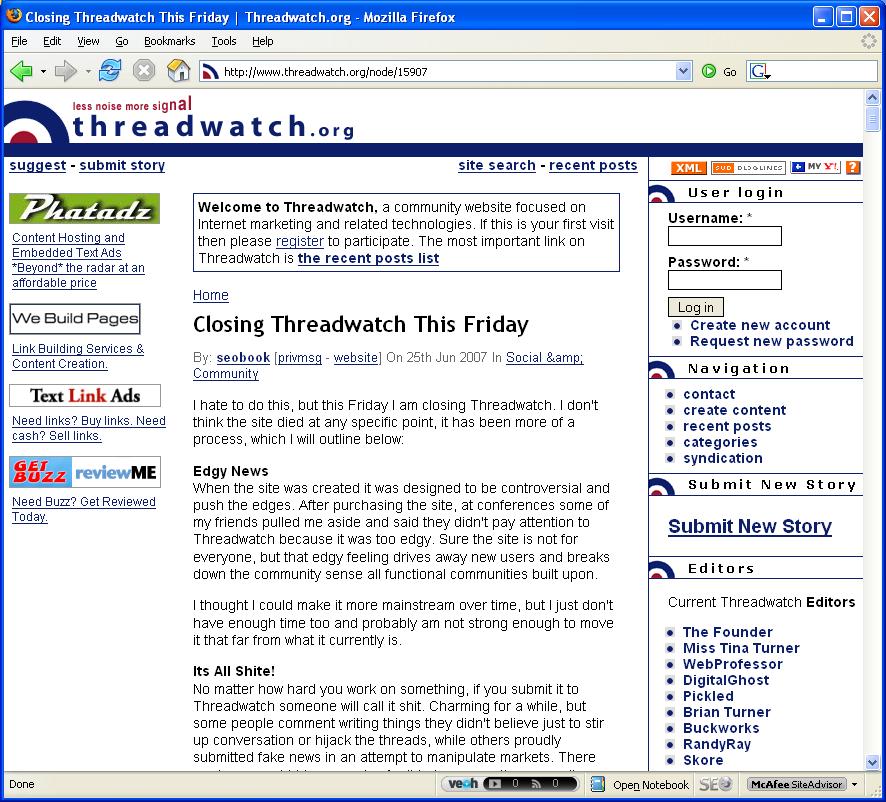
Threadwatch.org Will Die This Friday


Popular SEO/SEM (Search Engine Optimization/Search Engine Marketing) site Threadwatch.org will die this Friday, according to Aaron Wall, who has run the site since 2004 and explains the reasons for this unexpected closure in a lengthy explanatory note.

Wall's reasons for closing Threadwatch.org include the fact that many of his best contributors are now running Blogs of their own, the fact that Threadwatch.org was often spammed, and the fact that he's now got a girlfriend, who is commanding a greater share of his time.

These are all good reasons, and we wish Wall the best. I ran a community site called Netslaves.com for several years and doing so can run one ragged. One can almost get addicted to the fact that at any moment during the die, an exciting (or disgusting) new post can appear requiring immediate action. But over time, this kind of intensity can run one ragged, and one rarely is aware of the true opportunity cost of spending so much time hunched over one's keyboard until it's already too late.

The worst part of closing such a site is that one is almost guaranteed to catch a fair share of abuse from one's "loyal" community members, who seem to believe that you belong to them. Everybody needs to have a life and I'm glad that Aaron Wall finally decided to start living his while he's still comparatively young.

Labels: ,

June 21, 2007

More Updates to the Netslaves Archive

I continue to make steady progress on the task of restoring Steve Gilliard's work for Netslaves.com. My aim is to make all of Steve's articles available to the Web again, and expect the restoration work to take most of this Summer. The work involves a lot of HTML gruntwork, but it's worth it. I'm really enjoying reading Steve again, and his old articles really stand the test of time. In a funny way, I feel that I'm bringing his body of work home to where it all began so many years ago: on the servers of disobey.com.

Here is this week's chunk of restored material. It includes:You can read more of Steve Gilliard's classic articles for Netslaves.com by clicking here and here. This material will eventually be consolidated into one central archive.

Labels: , ,

June 15, 2007

From the Netslaves Archives: The Story of Jane

I've been digging through old CD-R disks in search of Steve Gilliard's lost writings for Netslaves. I figure it will take at least a year to locate all this material, and probably a decade to re-format it for the Web. Still, I think I owe it to my old pal to bring his lost writings back online. In the meantime, I'm discovering other artifacts from the Netslaves project that never made it online. Here is such an artifact: the story of an HTML programmer who worked for a corporation known as "Edler-Watson." This story was actually based on the memoir of someone who worked at Time-Warner's Pathfinder, but back in those days we changed the names because we were afraid of being blacklisted in Silicon Alley.

The Story of Jane
Jane Dantzig thought that she had seen it all. She’d worked in New York’s fast-paced New Media industry for a year, and paid her dues in high-tech sweatshops from Chelsea to Broad Street. Jane was a freelance HTML coder – a production grunt – one of the thousands of invisible people whose job it is to build, maintain, and refresh commercial Web sites so that the titanic dreams of their visionary masters can be realized, instead of sputtering to a halt on a broken link or a badly placed "DIV" tag.

Jane liked doing HTML – it would never make her rich, but it paid the bills. And she liked the independence the freelance life gave her even more. By being free to choose her clients, she could regulate the bullshit in her life, and control her destiny in a way that no full-timer, chained to the fate of her company, ever could.

Jane worked hard, didn’t goof off, rarely fucked up, and never kissed ass. But the mere fact that she controlled her destiny didn’t mean that she ruled Fate. And when Fate, in the guise of Challenger, Edler-Watson’s gigantic Web site, offered her a three-month production assignment in the Fall of 1995, Jane took the job.

It was a decision that led her into the Stygian depths of hell itself, and culminated in the single greatest disaster in the annals of New Media. For a brief 15 seconds that shocked the world, technology, human will, and reality itself suffered a simultaneous, cataclysmic failure whose ramifications are still being felt today.

It was the Day the Web Stood Still.

Hands-On
Jane’s long road to disaster began when she accidently injured the left foot of her African Grey Parrot, who had let himself out of his cage, and had mischievously alighted on the top of her bedroom door. The door closed, the bird howled with pain, and Jane immediately rushed the parrot, whose name was "Mr. URL," to the Animal Medical Center on 92nd street. X-Rays proved the bird’s mashed leg wasn’t broken, and Mr. URL was released within two hours, which made Jane, who felt horribly guilty, feel a bit better. But Mr. URL’s emergency treatment would cost Jane $320, and this was enough to send Jane’s carefully calculated personal economy into disarray, because she just didn’t have the money.

Jane blamed herself for always being short on cash, but it was part and parcel of the freelance life she’d been living for about a year. Formerly employed as a full-time professional typesetter, Jane had given up the steady life of twice-monthly paychecks to pursue a Web builder’s career at age 28. Because she knew page design inside and out, and had figured out that HTML was a much simpler page description language than the cryptic markup tags she’d been using for years to compose business forms, she quit her job and set up her own design shop, called “Rational Bits” in early 1995.

Although freelance site building provided Jane with a much higher hourly income than she’d made as a typesetter, she still found it difficult to make ends meet. Jane didn’t spend extravagantly, nor did she pay more than $1,000 a month in rent for her 1-bedroom on Waverly Place. The problem lay on the supply side of the equation: in the fact that many of her clients held on to her invoices for months, or sometimes didn’t pay at all.

By the fall of 1995, Jane’s accounts receivables were about $9,000 – about half of this from a slick uptown design house that built Web sites for several international petrochemical companies that, as far as Jane knew, weren’t hurting for cash. She’d hassled her debtor for two months, received plenty of promises, apologies, and assurances – but no check.

Another small startup that Jane built sites for went belly up after its largest client went broke, and never paid Jane the $5,000 she was owed. With her quarterly self-employment taxes coming due September 1st, Jane’s bank account was approaching zero, and she feared that she’d soon be unable to even afford parrot food, which meant she’d have to keep Mr. URL alive on pizza crusts.

"That’s not going to happen, sweetie, don’t you worry”, Jane said, as the parrot balanced on his good leg and made clicking sounds that sounded exactly like her keyboard.

Scanning The List

In the following days, Jane tried hard to drum up some business by continuously monitoring the job postings that scrolled across the New York World Wide Web Workers e-mail list. The WWWNY (or “Winnie”) list circulated among 2,000 Web professionals in New York, and it was a good place to hunt for freelance assignments. The Winnie list also provided a forum for a lot of quirky blowhards to rant endlessly about Aggro Software’s browser, or attack NetScathe’s flaky table support, but Jane tolerated the noise. She didn’t give a damn about the fate of VRML, or the future of interactivity – she just wanted to find a short-term job to pay her bird’s medical bill.

Unfortunately, most of the jobs posted to the list that week advertised intern positions that Jane was overqualified for.
“The fucking interns are ruining the job market”, Jane would complain.”
“Oh no”, Mr. URL answered back.

On Thursday, one listing did appear. It read simply:
HTML Production: Challenger
Long-term freelance opportunity. Must have extensive knowledge of HTML. Must be familiar with cross-platform, cross-browser compatibilities. Opportunity to expand your knowledge. Send email to production@challenger.com

Jane usually didn’t apply for long-term assignments, because most didn’t pay out until the project was completed. She’d already been burned twice speccing her time on long-term projects, and needed some instant cash.

She’d also heard weird things about Challenger from other HTML grunts who’d worked there.
“It’s chaos”, said one.
“Don’t go there. It’s a sick building”, said another.
“They use image-maps for everything”, said a third. But Jane fired off her resume anyway -- she didn’t want to feel that she’d left a stone unturned in her search for work.

On Friday, Jane was going over her $239 Bell Atlantic bill, when her mother called from Cincinnati. She hated to hit her mother up for money, but realized that if she didn’t, she’d be relinquishing her best shot of making it through the next week.
“Have you ever thought of trying to find a real job?”, Jane’s mother asked.
“Mom – I’ve got six jobs. I’m making more money freelancing than I could at a real job.”
“If you’re making more money, why are you asking me for a loan?”
“InterPetrol owes me $6,000. They’ve got to pay me -- I just don’t know when.”

After wrangling for a few more minutes, Jane’s mother agreed to mail her a check for $600, a sum that would go a long way in Cincinatti.
“Shit”, said the parrot.
“Well, it’s something”, Jane said.

Picking up Fares
Jane’s luck began to change the following week, when she got a call from LaserCrab, an ultra-hip downtown design house, asking her to come in for a couple of days of HTML coding. She’d worked at LaserCrab before, and had profoundly mixed feelings about going in, because its rarefied, design-driven atmosphere was, as she put it, “all sizzle and no steak.”

Jane also felt out of place among its pretentious crew of 20-something design mavens, who drank endless amounts of coffee, discussed Foucault and Hegel, and produced top-heavy, Java-dependent prototypes that seemed to crash every browser except the latest Mac version of NetScathe. Even though she felt like a hick in the place, Jane went down and spent three full days trying to unravel the weird code the designers’ WYSIWIG editors spat out.

The next week, she landed a two-day shift at Hedge-Downs, a publishing company that had recently fired 30% of its work force in a bloody restructuring, but still needed to crank out Web pages with gigantic tables comparing hundreds of computer components. Unlike LaserCrab, whose SoHo loftspace was a packed, dingy sweathouse of activity, Hedge-Downs plush offices were practically empty – either the editors were all at Comdex, or they’d all been fired.

Jane took Thursday and Friday off – her hands and wrists were hurting her, not so much from typing, but from clutching the crappy, non-ergonomic mouse that Hedge-Downs had made her use. Living with pain was something that Jane had grown used to, but as long as she gave herself a few days of recurperation from frenzied clicking, it seemed to disappear. She hoped she wasn’t doing permanent damage to her wrists, but really didn’t know – she hadn’t seen a doctor in a year, because she had no health insurance coverage.

She e-mailed her two invoices off – 32 hours of work, at $30 an hour – a grand total of $960 billed to two solvent clients who’d been pleased with her work. $30 an hour was the going rate for HTML production people of Jane’s caliber – fast coders who checked their work, proofread and corrected mistakes (even if they weren’t theirs), and made sure that all was safe and sound on the servers before clocking out for the night.

Short-Timer
Jane knew that neither RazorCrab nor Hedge-Downs would be likely to call her back soon – both companies were looking for a full-time coder that would work cheaper than Jane, and they’d probably fill the positions before too long. In truth, these companies only called in Jane when one of their people burned out – a fate that often stalked full-timers who were forced to do HTML, and nothing but HTML, for months without a break.

Jane actually enjoyed producing massive tables, cleaning up crappy code, and all the other minutia associated with hand-crafting HTML pages. But she couldn’t bear the thought of doing HTML all day, every day. Beyond the torture it inflicted on her extremities, Jane also suspected that too much Web production could actually drive one crazy. After a certain point, it became like Chinese Water Torture – a sinister thing whose evil lay in the fact that none of its victims ever believed that innocent little drops of water could be capable of inflicting such crippling psychic pain.

The fear of mindless repetition, beyond any any other reason, lay at the root of Jane’s hatred for permanent jobs. It wasn’t, as her mother suggested, that Jane was “afraid of commitment”, or “suspicious of long-term relationships”. Jane had nothing against men, beyond the fact that most were hopelessly messy creatures who felt they’d been granted an inaliable right to interpose themselves in Jane’s life, and talk for hours – usually about themselves. In this respect, they were like Mr. URL, but took up much more space.

If Jane had had the time to see a shrink, he might have advised her that her strong bias towards “independence” might be causing her to miss out on things that only long-term relationships bring: security, a family, a sense of being more than a nomad who lived by the clock. But Jane had no desire to change her life – it hitch her chain to some flaky man, or an even flakier Internet startup. And Jane’s reluctance to “commit” to long, drawn-out affairs of the heart, or of the workplace, stemmed from the simple fear of boredom – the dreary, mind-numbing sameness that, like Water Torture, ultimately became unbearable.

The Challenge
On Saturday, around six PM, the phone rang – it was Challenger’s Head of Production, calling about the resume she’d sent in a week before.
“I need coders”, the voice said. “Your resume looks good. What’s your availability?”
“Well, this week is clear.”
“Report to 3724A. You’ll need a visitor’s pass. Be there at 10:00”.
“But I…”
The phone clicked. It was the shortest conversation Jane had ever had.
“Oh no”, said the parrot.
“Well, we do need the money”, Jane answered.

On Sunday, Jane was sleeping late, when the phone rang again.
“Where are you?”, asked the voice, and it took a few seconds for Jane to properly associate it with Challenger.
“I thought you were talking about Monday”, Jane said.
“I’m talking about now”, he said. “Can you make it in or not?”
She looked at her clock radio, which read 10:20.
“I’ll be in as soon as I can”, she said.

Jane took the 6th Avenue subway up to the Edler-Watson building – a 50-story, modernistic slab of concrete in the low ‘50’s. She got a visitors’ pass from a sleepy guard in the visitor’s center, and waited for the elevator. The lobby was empty and echoic – a mournful mausoleum to 1950’s modernism. But when she stepped out on the 37th Floor, and was buzzed through Challenger’s security system, Jane entered a scene of bustling activity – people were darting back and forth among a long corridor of cubicals that stretched the entire length of the building’s East wall.

Jane began to sweat – it was hot in the massive room, and clouds of condensation had formed on the inner services of the sealed pane glass windows. She wandered through the bullpen of cubes, and circled back to the entrance, disoriented and confused. At last she found Room 3724A, a small, windowless office that she’d walked right by when she came in, mistaking it for a utility closet.
“I’m Jane Dantzig”, she said to the man hunkered down behind two gigantic monitors on a cluttered wooden desk.
“Good”, he said, without looking up. He rustled with some forms, and handed them to her. “You need to fill these out, and these, and these. Your rate is $20 an hour. Fill out the time sheet when you’re done.”
She filled out the tax forms and waited for more instructions from the man, but he was busily clicking away at something.
“It’s pretty hot in here”, Jane said.
“Building services doesn’t like running the air conditioners on weekends”, he said.
“What would you like me to work on?”, Jane asked.
“We’re redesigning the site today”, he said. “I need a report on broken URLs. Find a vacant cube.”
“Do you want me to fix them?”
“No. Just a report”.

Jane found an unoccupied office near Challenger’s coffee machine, and logged on to the network. She launched NetScathe, and began tooling around the Challenger site – a massive collection of content from about 80 of Edler-Watson’s magazines. She explored the sites’s top level pages, and although they were slow-loading, image-mapped monsters, none of them were actually broken.

But when Jane began exploring the pages of the magazines themselves, she found hundreds of errors, and had soon filled up an entire page with notes on their locations. By the time she was ready to leave, around 8:00 PM, she had accumulated a list of about 1,400 hundred bad links.

The Production Head studied her printout. “That’s good. That’s very good”, he said. “Can you come back tomorrow?”
“I’d like to, but I usually get $30 an hour”, Jane said.
“You’re just checking links. This isn’t rocket science.”
“Yes, but if I do this gig, I can’t do my other jobs, which do pay me $30 an hour”, Jane said.
“Well, I could probably use someone on PowerStager. It’s rolling out next week. I tell you what - I’ll pay you $25 an hour, but we’d have to train you, so you’d have to agree to stick around to make it worth our while.”
“All right”, Jane said.

PowerStager
The next day, Jane began to learn how to operate PowerStager, an elaborate piece of software designed in-house by Challenger’s software engineers to streamline the way content was uploaded to the site. PowerStager was built to correct a problem that had plagued Challenger from the beginning – a problem known as “Update Gridlock”.

Challenger, like many large Web sites, used two physical machines to store its massive collection of content: a public server, and a staging server. Editors would “fetch”, or FTP new content to the staging server, and then, after a period of time, the staging server would refresh the public server, so that users could see the new stuff.

Unfortunately, as Challenger aggregated more content, and refreshed content more frequently, the staging queue often backed up, causing the time lag between server refreshes to grow to a point where it might take three or more hours for a “fresh” news item to appear on the public servers.

Challenger’s Editor-in-Chief, Jeff Marshall, yelled and screamed about Update Gridlock, because it caused Challenger to get “scooped” on breaking news stories. Others were screaming too – sometimes, the site’s hopelessly constipated content queue would actually cause the staging server to fail, which caused a wave of hair-pulling and subcritical brain embolisms to sweep through Challenger'’ short-tempered crew of editors. Each knew that in a matter of moments, their phones would light up, and they’d be treated to obscenity-laced tirades from their Content Partners, who couldn’t update their sites.

PowerStager, on the other hand, was designed to selectively bypass the staging server, so that Challenger’s editors could write content directly to the public server – a very powerful, but very dangerous capability that filled the tech team with dread. The potential for disaster -- through accident, miscalculation, or madness – was very real, because PowerStager provided a way for technically inept editors to inadvertently overwrite the entire site – the equivalent of typing “FORMAT C:\” in a DOS window. If this happened, the technicians’ only recourse would be to restore Challenger from an archived tape drive, a maddening process that took them three days to finsh in their dark, subterranean server farm complex across the street.

To prevent any unauthorized overwriting, PowerStager’s Web-based interface was deliberately made very complicated, to mislead Challenger’s editors into believing it could only update a single file at a time. As a secondary security measure, PowerStager included a feature which forced editors to click through three seperate “ARE YOU SURE YOU WANT TO DO THIS?” screens before they could update anything. As a final line of defense, PowerStager automatically created a log file capturing the IP address of the updater, and, it was rumored, “did a lot of other things” to identify editors screwing with the public servers without permission.

Bugs
While Jane had no trouble understanding the theory behind PowerStager, she found its practical operation somewhat erratic. When she tried using the software to move some non-critical test files to a test directory, she observed that it only worked about half the time. Sometimes the GIF would arrive corrupted, and HTML files didn’t always arrive intact either. PowerStager also seemed to slow down at certain points in the day, which meant that Jane had to wait around for 10 minutes before she could get through all the “ARE YOU SURE YOU WANT TO DO THIS?” screens.
She called up her contact on the Tech Side about this.
“We know all about the bugs”, he said.
“Is it something I should worry about?”
“When it launches, they’ll be gone”, he said.

By Wednesday, Jane noticed that some of PowerStager’s bugs had been eliminated, but others were mysteriously appearing. Sometimes PowerStager would “hang” in the middle of an operation, forcing her to reboot her machine. Sometimes her hard drive would start spontaneiously spinning by itself – Macs had a tendency to that, of course – but it still seemed peculiar, and Jane wondered if PowerStager wasn’t probing her machine for reasons of its own. Later in the afternoon, Jane received a real scare when a file she was working on completely vanished from her desktop, even though she hadn’t deleted it.
“That’s a new one”, said the engineer. “It may have something to do with the resolver.”
“Sounds a lot like Rocket Science”, Jane said.

The OJ Files
Before Jane left for the weekend, the Production Head specified that she make a special attempt to arrive early on Monday – something important was going on.
“Another redesign?”, Jane asked.
“No, it’s this OJ thing”, he said.
“What’s the OJ thing?”
“Aren’t you following the trial?”
“No”.
“Well forget about it. Just be in place early. It’s probably going to be a busy day.”
“OK”, Jane said, signing her time slip.

Jane spent a quiet weekend at home, and didn’t think much about OJ Simpson, Challenger, or PowerStager. She was aware that OJ had been on trail in Los Angeles for months, but had more or less blanked it out. The whole thing seemed to have very little to do with her life – it happened far away, in a city that she didn’t like very much.

But Challenger felt very different about the fate of OJ Simpson, and one of its most popular subsites, OJ Central, had served as the Internet’s greatest single touchstones for Web users who, in many cases, seemed obsessed by the whole saga. OJ Central provided an interactive map of the murders, daily trial transcripts, and a message board which teemed with thousands of ranting, raving, and hand-wringing opinions on what the whole mess meant to the future of the Western World.

Like the networks, Challenger was making big bucks off of OJ, and knew, as Jane did not, that it was likely that the Simpson trial would likely reach a verdict on Monday, October 3rd. So to capitalize fully on their expanded OJ coverage, Challenger had made it known to OJ Central’s users that it would be the first site to announce OJ Simpson’s verdict, within minutes of its rendering.

Over the weekend, an emergency OJ team camped out in the overheated confines of Edler-Watson’s 37th Floor, planning the best way to make sure that nothing went wrong. Although everyone on the OJ team believed that Simpson would surely be found guilty, they didn’t take any chances, so the Art Department was instructed to prepare two different, image-mapped GIFs to replace Challenger’s default home page. One read “GUILTY!”, and showed a dour, depressed OJ Simpson appearing to scream at the Judge. In an inspired flourish, the GIF also included within its sidebar the ominious notice that said: “LA POLICE ON ALERT”.

The second home page, “OJ Innocent”, showed OJ Simpson in a completely different pose: quiet, somber, and beautifically grateful to the jury that had let just him off the hook. Obviously, no “reports” of the LA Police’s alert status were included in this image. Temporary pieces of ersatz text reportage were hammered out by Challenger’s News Editor, to serve as placeholders until someone could grab enough text from an incoming Reuters wire report to flesh things out in more detail.

By late Sunday night, all of the new OJ content had been finished, the weary team had retired for the night, and all the OJ Files were plopped into two folders, named GUILTY and INNOCENT, which sat on Challenger’s LAN.

Apocalypse
At 8:30AM on Monday, Jane took a position in her cube, and waited for instructions from her masters. It was quiet in the Challenger’s massive bullpen, but things came to life when its staffers started appearing around 9:30, with members of the OJ team looking sleepy and unkempt. A large 21-inch television mounted on the wall was turned on at 10:30, and Jane listened into the pre-verdict coverage on CNN. The OJ jury had been sequestered all weekend, and, and reliable sources said that they were finally ready to pronounce a definitive verdict on the football player’s crime.

At 11:30, a small crowd began to gather around Jane’s cube, which was right below the big TV. Minutes later, Pathfinder’s Production Head soon appeared at Jane’s cube, and showed her where the INNOCENT and GUILTY folders resided on the LAN.
“Okay, all you have to do is make sure that the right files go up”, he said. “Just select the right folder” when I say “Go”, and get through those damned confirmation screens as fast as you can”.
“Right”, Jane said.

At 11:59, all of the major networks pre-empted their normal programming, and switched to a live satellite feed from the LA County Courthouse. The OJ jury filed out of its deliberation room, and the foreman began speaking into a microphone.
"We find the defendant OJ Simpson... Not Guilty of the crimes..."
"Go," said the Production Head.

Jane dragged the INNOCENT folder into PowerStager’s “put” window, and hit OK. She rapidly clicked three times more, to get through the confirmation screens. She then switched to Challenger’s home page, and hit “Reload” on her browser.

It was a moment that was just like the expanding, slow-motion, head-through-the-windshield impact of a terrible car crash. All the moments of Jane’s life seemed to pass through the terrible funnel of that frozen five seconds. Time stood still, and there for all the world to see on Challenger’s public servers, was the wrong home page – the one that said “OJ Guilty: LA Police on Alert”.

Jane had just uploaded the wrong fecking file.

“SHIT!”, the Production Head said. “Oh Shit! UPLOAD IT AGAIN. AGAIN.”
Jane repeated the steps in PowerStager. She hit reload again. An interminable moment passed as the browser’s cache refreshed.
“OH, Thank God. Thank God. It’s OK. It’s the right one”, said the Production Head, his face whitish, drained of blood.

A relieved murmer rippled through the room. People started to return to their cubes, although they remained in a state of shock, because few among Challenger’s staff believed that OJ Simpson was innocent of murder.

But within an hour, there was more bad news. Although the OJ GUILTY GIF had been on the public servers for less than fifteen seconds, a user in the Far East had retrieved the file from his cache, posted it to a Web site, and was spamming USENET with news of Challenger’s mistake. All through that terrible afternoon, “OJ GUILTY” mirror sites sprang up all over the Web. By five o’clock, Ruport Murdoch’s own site, iGuide, was running a headline story comparing Challenger’s journalistic fumble to the legendary “Dewey Defeats Truman” newspaper debacle of 1948.

"Jane," said the Production Head. “We’re going to have to talk about this”.
And with that, he called her into his office, and closed the door.

“What do you mean, I’ve got to appear at a hearing?”, Jane asked the Production Head.
“It’s not a hearing – it’s more of a fact-finding conference”, the man said.
“I don’t think I want to get involved in this.”
“Well, the Editor-in-Chief wants to get to the bottom of this. There’s a lot of fingerpointing going on here – the Editors are blaming the Art Department, the Art Department is blaming the Tech Side, you’re blaming the software, and some people are blaming you.”
“I know the difference between a folder called INNOCENT and one called GUILTY”.
“I believe you, but can you convince them?”
“Look mister. If you’re going to make me the central figure in some kind of an inquest, you’re going to have to pay me a lot more than $25 an hour.”
“What’s your price?”
“$50”.
“It’s high”, the man said, “but I’ll pay it”.
“Yeah, well I’ve got better things to do”, Jane said, and walked down the corridor toward the elevator. She never came back.

Verdict
Jane was the only one of the various participants in the Great OJ Disaster who refused to attend the grueling, day-long inquest that was held to investigate the incident. As a result, she was fully blamed for the whole thing – one editor speculated that Jane, being a woman, couldn’t bring herself to believe that OJ Simpson was really innocent of murdering his wife. Instead, in a “trancelike state of denial”, she’d acted reflexively, without thinking, and grabbed the wrong folder. One woman at the inquest objected to this interpretation, and suggested that Jane was probably just a closet racist, who just couldn’t handle the truth.

But the inquests final report rejected both of these interpretations, and simply concluded that Jane was an incompetent who should never have been hired in the first place. She was quickly removed from Challenger’s list of “approved” freelancers, and was never called back to the site.

Epilogue
Although PowerStager’s role in The Great OJ Disaster briefly surfaced at the inquest, no one seriously believed that such an elegant piece of software could possibly have mixed up the INNOCENT and GUILTY files, and it was placed in service the next day. All ran well for a couple of weeks, until, one morning, Challenger’s entire site disappeared from the Internet, just after the News Editor updated a small, insignificant file to the public servers. After technicians spent a week restoring the massive site, PowerStager was quietly taken down for “routine maintenance”, and was never returned to service.

Jane, on the other hand, is still in service, and continues to live with her parrot on Waverly Place. She still builds Web sites in New York, and still makes about $30 an hour. She rarely thinks about OJ Simpson, or the Great OJ Disaster, but admits that if she ever saw another copy of PowerStager, she’d run a knife through its heart.

No jury would ever convict her.

Labels: ,

June 13, 2007

The Day That Sydney Schanberg Invited Netslaves' Steve Gilliard to an Editorial Rumble

When Netslaves hired Steve Gilliard as writer and "media operative" in early 2000, we knew that we were in for a wild ride. Gilliard had already proven himself to be a sharp-barbed skewerer on Silicon Alley's WWWAC list, so we knew that whatever he did for Netslaves would likely create enemies. But none of us knew that his first major action for us would be to piss off Sydney Schanberg, one of New York journalism's major luminaries, to the point that Schanberg invited our editorial team to an impromptu riot.

The whole mess began after Schanberg, the Pulitzer Prize-winning author of The Killing Fields, hooked up with a project called APBNews.com. Remember, this was a time when many Old Media journos (including Lou Dobbs) were bailing from their slow-moving Old Media companies and staking their claims in cyberspace. APBNews.com was among the first of Silicon Alley's content startups to get into serious trouble, and when it began to run out of cash in June of 2000, it asked its staff to continue to work for the site for free.

Gilliard saw this as an outrageous assault on the principle that writers should be paid for their work, and immediately attacked APBNews in what he called "An Open Letter to APBNews" He began it with the following passage, which is one of my all-time favorite Steve Gilliard openings:

The crash and burn of APBNews.com was no surprise... except to its employees.

They called you in at 9:30 AM Monday and said it was over. That's right. It went from 140 employees to zero just like that. Management never dealt honestly with their people and were still hiring until the final countdown. They had given you the news after a weekend where you were feted at the Waldorf Astoria Hotel's ballroom. That's one of the best places on earth to eat mediocre hotel food.

The reaction to Gilly's missive was stunned, hurt, and vituperative. ABNews.com's semi-employed survivors wasted no time lambasting Netslaves.com, not for what it wrote, but for the way it was written:

Name: David J. Krajicek
Email: dkrajicek@aol.com
Comment: You see, Mr. Gilliard, APB--however flawed--was a news site peopled by adult journalists. Someone like you, who posts infantile, uninformed screeds, who confuses obscenities with deep thought, who so desperately needs a professional copy editor reading his work, could never understand.

Others supported Gilly, and all day, an escalating flame war consumed the pages of Netslaves.com. Finallly, Sydney Schanberg himself laid down the challenge:

Name: syd schanberg
Email: sydney.schanberg@apbnews.com
Comment: I'd be much more impressed by the brave insults gratuitously spewed at us by Messrs. Gilliard et al if they had the spine and character to come to our news room at 65 Broadway and deliver them in person. Do come. Show us you're really grown-ups. Sincerely, Syd Schanberg


Netslaves' Bill Lessard, somewhat stunned by our close brush with journalistic royalty, asked Schanberg to clarify:

Email: netslaves@hotmail.com
Comment: Syd,
Should we bring baseball bats? Does this mean that you want to rumble? Sorry to sound arch, but if you don't agree with us, that's fine. Call us idiots, dismiss us as sub-literate morons, but don't cheapen yourself with threats.


We didn't hear back from Syd, so we didn't make a move. Maybe we copped out by not grabbing a bunch of hand tools and heading over to 65 Broadway. How tough could Schanberg et al really be? But was the challenger really Schanberg or just an agent provacateur? (this all happened before we installed IP-logging on the site).

I'll always wonder what the outcome of a physical struggle would have been. But we never took Schanberg up on his challenge, because we really didn't know what to bring. Clubs? Bolt-action rifles? Lawyers? So we just pulled down our window shades, made sure that we weren't being followed, snd stayed close to our computers, stoking the virtual fires from Yonkers and East Harlem.

It was clear that Steve Gilliard was unafraid of breaching one of New York journalism's most important but unwritten rules: that you must never, EVER attack one of your own. From that moment on, we knew that Gilliard was a major talent. Having this kind of talent on staff might get us all killed, or at least blacklisted as working journalists, but way back then, when we were young and spry, we just didn't give a damn.

For further informed vitriol on "l'affaire APBNews.com," see Steve Gilliard postings on APBnews.com's demise:

Labels: , , , ,

June 12, 2007

Anti-Gilliard Blogger Impales Herself on Her Own Posts

No, Steve Gilliard didn't reach out from beyond the grave to "take out" a Blogger who posted racist remarks about Steve while cashing an ABC paycheck for WKRN, a radio station in Nashville, Tennessee. This person, whose name is Brittney Gilbert, reposted vicious remarks about Steve that I will not repeat here. While she did not write these words, she posted them without distancing herself from them, and in her farewell message, she side-stepped her own responsibility by blaming the Blogosphere and calling it "a mean place."

Let me tell you something, Brittney Gilbert. The Blogosphere isn't "a mean place;" it's just transparent. If you make an outrageous, indefensible statement, or repost same without putting it into the proper context, it will come back to haunt you. John Lennon called this "instant Karma" but I'm almost positive you've never heard of him. You can play the victim game all you want but unless you accept some personal responsibility here, you will continue to misunderstand this game and will likely repeat your mistake again and again.

This isn't a left vs. right wing thing, Ms. Gilbert. It's about the limits of acceptable discourse in a civil society. Believe it or not, there are actually ways you can express disagreement with a point without resorting to name-calling or epithets. Please try to find them, and remember: the Web isn't a consequence-free video game, regardless of which corporate logo you wear on your sweater.

Labels: , , , ,

June 11, 2007

NPR Pays Tribute to Steve Gilliard

There's an excellent radio piece on Steve Gilliard's life and work on NPR's Web site. This 2-minute segment was produced by Farai Chideya. You can listen to it online.

Labels: , ,

Updates to the Netslaves Archive

I was busy over the weekend digging up more ancient content that Steve Gilliard wrote for Netslaves.com in its early years. I've found a lot of material and will be restoring it in chunks as time permits. So here's a chunk of vintage Steve Gilliard content from early 2001. More to come soon! (Note: If you want to see all of the articles that were written for Netslaves in this time period (not just Gilly's contributions), please inspect The Netslaves Archive.) If you want to know which of these articles is my personal favorite, it's definitely Valentine's Day: The Meaning of Hell (What To Do On the Most Miserable Day of the Year?)

This week's restored Steve Gilliard Articles:
A list of Steve's pre-February 2001 articles for Netslaves.com is available here.

Labels: , ,

June 08, 2007

At Steve Gilliard's Wake

I got up to Steve Gilliard's wake last night. I hadn't been up in East Harlem in years, but lived on 116th Street during the late 1980's, and the neighborhood is much as I remember it. Steve's wake was at a funeral home on 104th Street and 2nd Avenue.

When I showed up at around 5:00 PM, the viewing room was very quiet, and those assembled were mainly his family and neighborhood friends. But many others soon showed up: friends from NYU, and from the Blogosphere, including Markos Moulitsas Zúniga of the DailyKos, several folks from FireDogLake, Bill Lessard, of the NetSlaves project, and many others who had known Steve from cyberspace. Of course, Steve's longtime friend Jen was there.

As the crowd swelled, the silence yielded to many soft-murmered conversations celebrating Steve's life and achievements. We paid our respects and headed out into the warm night. It was sad to know that we had seen his face for the last time in this world.

Steve's funeral was today, in New Jersey.

Labels: ,

June 07, 2007

Is FeckedCompany.com a Ghost Site?

FeckedCompany.com, a site against which Netslaves.com fought a disastrous war which ended in 2003 with the destruction of Netslaves.com, appears to finally have succumbed to the forces of entropy. Its once-popular Bulletin Board now yields a "Server Not Found" message. Word on the street is that Phil Kaplan, AKA "Pud" agreed to muzzle FC.com to smooth the acquisition process for his ad company, Adbrite, which is now backed by Sequoia Capital, a fabulously wealthy VC firm.

Steve Gilliard thought a lot of Pud, and FC.com became the most popular site of the so-called "post-boom" dotcom era. But it's time has passed, and Phil Kaplan has reconstituted himself as an online ad baron. Good: Phil worked hard enough, although I remain critical of the way he ran his board. Everyone is entitled to a few sour grapes.

Labels: , , ,

June 06, 2007

More on Steve Gilliard from the Netslaves Archives

I was rummaging through an old, uncompleted draft of a "History of Netslaves.com" document that's been languishing online since the Summer of 2003. You can read this document here but you'll probably find most of it boring (unless you're a true Netslaves freak).

I was chuckling about the section I wrote about Gilly. Here it is:

JANUARY 1999: STEVE GILLIARD EMERGES

Steve Gilliard's arrival on the Netslaves List in January of 1999 portended a different brand of change for the site's stream of text. Robin Miller might have been the wise old uncle in the trailer, but Gilliard represented a new, hitherto unseen urban breed of tough-typing, take-no-shit tech journalists inspired by such editorial firebrands as Jimmy Breslin and Murray Kempton.

A Harlem denizen whose DIY ethos and low toleration for being lied to had already made him enemies on New York's influential World Wide Web Artists' Consortium Mailing List, Steve Gilliard would soon become Netslaves.com's most prolific writer. He would also figure prominently in the most critical, traumatic moments the site would experience in the next few years - especially in 2002. The tone Gilliard set - the voice of a man who had seen it all and who plainly had had enough of it, would significantly influence the site's sharp-edged tone in its first year of operation. It would also frequently antagonize people who felt - rightly or wrongly - that he had a particular personal animus against them.

Here is a classic example of a Gilliard-ism directed toward Micheal Wolff - the author of 'Burn Rate' - that appeared on the List in January of 1999:

Well, I can discount the asshole factor as well. But, he's both wrong and an asshole. Around NY, his book, Burn Rate, is widely regarded as fiction. I don't know anyone who takes him seriously in NY. David Futrelle, Austin Bunn, and a number of people I've interviewed for an article on Wolff, have absolutely no respect for his opinions.

He's little better than John Scully. A failed manager selling his expertise.


Gilliard minced no words, suffered no fools, nor did he give an inch when challenged. While others were sleeping, or watching TV, or trying to forget about the scandal-ridden inequity of the New Economy, he was up. Often, like Miller, his responses to queries were borderline brusque one-liners that made your brain bristle with what certainly appeared to be arrogance. He painted a picture of himself as a guy you didn't want to cross - on a list such as http://www.wwwac.org/ [site], on a Web site, or presumably, on East 118th Street. If he didn't like what you had to say, he'd one-line it, and throw it back in your face - a brusqueness that some find hard to take. In person, offline, in public, it was another matter. Gentle, circumspect, more nuanced and more forgiving than any amount of text-parsing of his online toughness would ever indicate.

On the NS List, poised, at any hour of the day or night, to strike at anything that set off his bullshit alarm, Gilliard was fierce, hyperactive and dug deep enough to bring forward something from the vast data pit of the Web good to resonate with the peculiar space the community was in.

Gilliard was the best that Netslaves had - a tiger who wanted, more deeply than anybody the authors had so far encountered - to do journalism online - with a vengeance. He was also one of those people who seemed to never sleep (Baldwin, who had lived in East Harlem during the early 1990's, speculated that the reason that he was online so much was to escape from the streets, which rolled up at night in that part of the world, making any physical move into RL a potentially deadly experience).

There was a mystique about him that you couldn't really beat. When UrbanExpose's John Lee stepped from behind the shadows, Gilliard knew exactly who he was. He was relentless, omnipresent, like, as Lessard would describe him, 'an angry Burt Lancaster'.

Regardless of the cause underlying his restless, hyperactive online behavior, Gilliard's emergence brought with it a broadening of the site's content beyond the close world of the back-office into the far more frightening world of military history, sports issues, and sex - a subject that Gilliard was as willing to broach as Robin Miller. He had learned his online ettiquete late, from mailing lists, USENET, and on his own. The authors - older, steeped in outmoded, Compuserve and Prodigy-era administration rules - sometimes could not understand it. But they tolerated it, because Gilliard was, from the very beginning of the NS List, the mainspring of discussion. He was there - all the time - and he kept the posts flowing.

By March of 1999, discussions on the list had trashed (or at least violently deconstructed) Jeff Bezos, Joe Firmage, Candace Carpenter, Bill Gates, Eric Raymond, Richard Stallman, and Michael Wolff. Popular conversational topics included worker discontent at Amazon.com, volunteer discontent at AOL, and Other, more peaceful threads discussed movies, music, and books. Polls included 'Are You a Slob?', 'Your Longest Day, 'Your Shortest Job', and 'The Worst Part of Your Day'.

Labels: , ,

New York Times Obituary: Steve Gilliard

The New York Times posted an obituary for Steve Gilliard on its Web site; this notice also appeared in the Times' print edition. A few days ago, I suggested that the mainstream media would completely ignore Steve's passing; I am very glad that I was completely wrong about this.

Labels: , , , ,

June 05, 2007

Donations for Steve Gilliard's Funeral

Steve Gilliard wrote his heart out for the Web but never made a lot of money. There will be a service for him in Harlem this week and funerals are expensive. If you want to donate to his funeral fund, please visit his Website and click on the PayPal icon. All monies go directly to his family.

Labels: , ,

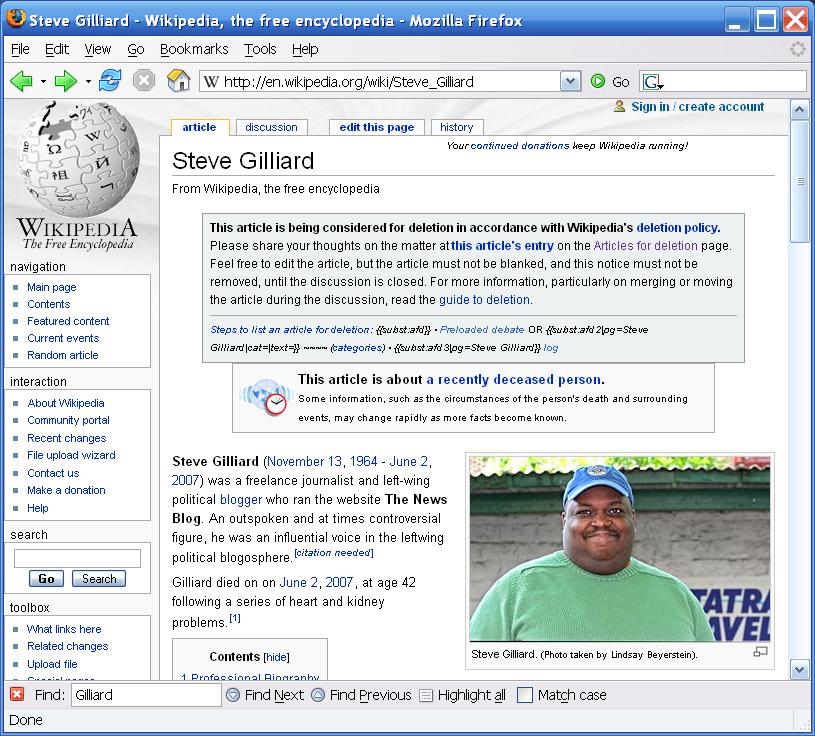
Steve Gilliard May Be Deleted From Wikipedia.org


This one just makes me sad. Steve Gilliard's Wikipedia entry is being considered for deletion. His detractors insist that because he wrote for the Web, he isn't noteworthy enough to remain there.

Fear not, Steve, wherever you are. Your memory will live on here and on other sites whose admins know who you were. Those Wikipedia weenies can go to Hell.

(Update 6/5/07 5:48 PM EST: The "subject to deletion" notice has been removed from Steve's entry. Thanks to the Wikipedia gatekeepers for letting sanity prevail).

More on Steve Gilliard, including my memories of him and a list of articles he wrote for Netslaves.com, here.

Labels: , , ,

June 03, 2007

Remembering Steve Gilliard (1964-2007), a "Web Writer and Damn' Proud of It"

Steve Gilliard, 1996-2007